
“The environment must be rich in motives which lend interest to activity and invite the child to conduct his own experiences.”
Maria Montessori
The Early Years Foundation Stage and Montessori Curriculum
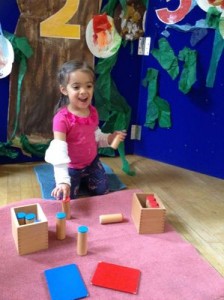 The vast range of activities we have on offer aim to introduce the children to the subject areas they will be taught formally when they reach school age in a simple, fun and enjoyable way. We strive to stimulate children’s language development and extend their vocabulary through every activity. Children experience the first steps of reading & writing, mathematical problem-solving, science, geography and nature studies through a variety of different learning experiences. We believe that creativity has an important impact on all areas of children’s development and therefore there are daily opportunities for children to participate in singing, dancing, music, story-telling, role-play and arts and crafts. The daily provision also includes sand, water and other malleable resources to enable the children to relive real-life experiences, express their emotions and begin to understand what is happening in the world around them. Children will also experience a variety of ICT, including the use of computers, for different purposes.
The Early Years Foundation Stage
The EYFS lays out a variety of Early Learning Goals that each child should achieve by the time they reach the end of the Reception year at school. All of the activities in our Montessori nursery help to develop your child’s skills in these Seven key areas of learning:
Prime Areas of Learning:
- Personal, Social and Emotional
- Communication and Language
- Physical Development
Specific Areas of Learning:
- Literacy
- Mathematics
- Understanding the World
- Expressive Art and Design
We often focus on a theme or topic for a period of time e.g. week, fortnight or half term. However, each key person assesses their own key children’s needs and plans for individuals.
National Curriculum / Start Right Montessori Curriculum
National Curriculum
Start Right Montessori’s curriculum is clearly laid out with reference to the government’s attainment targets and key stages, enabling parents to clearly understand their child’s progress. Montessori education is particularly suited to achieving the cross-curriculum approach encouraged by the National Curriculum. The idea of cross-curriculum themes was originated by Dr. Montessori and is achieved by regular project work encompassing and developing many different subjects at the same time.
Start Right Montessori Curriculum
The emphasis in the Montessori classroom is on the inter-related nature of the various subjects taught. Traditional areas of study are complemented by subjects reflecting a rapidly changing world – History, Geography, General Science, Music, the Arts, Drama and Physical Education are joined by Information Communication Technology (ICT) and Design & Technology.
 Our children are encouraged to do further research in their class and individual projects by field trips and excursions. We have had recent visits to the Science Museum, Wildlife Paradise park, London Aquarium, Willow Farm and our Local Vet to name but a few. Additional trips to theatres for special drama productions and workshops have also been arranged.
In addition to core subjects, a number of optional sessions are available including: French, Spanish, Singing, Drama, ICT, Cookery, Art and Dance.
7 Areas of Development Skills
A feature of Montessori education is that each child is continually observed and assessed by their teachers. Parents are requested to meet the teachers once per term at which point they will discuss their child’s progress.
At Start Right we strive to develop children’s communication and language through every part of the daily routine. Young children have an astonishing ability to absorb language and every effort is made to give each child as broad and as precise a vocabulary as possible.
We provide plenty of opportunities for children to express themselves both on a one-to-one basis and to small or large groups. We provide children with activities that support their learning and further develops their self-confidence. The Montessori classroom is designed to help your child reach the 3rd period of consciousness and therefore your child is learning at their own rhythm. This allows your child to concentrate on the learning of each important step in language so that each progressive step is achieved with ease. The Montessori materials also play an important role in aiding your child to develop the powers of communication and expression, of organization and classification, and the development of thought.
We naturally focus on offering children rich oral language experiences and provide children with an organised and accessible environment.
The Sounds of Language
In the Montessori classroom, phonetic awareness begins with the child’s knowledge of sounds. The child must be able to hear the sounds in words. We support children to hear individual sounds by:
- Annunciating slowly and carefully
- Encouraging the children to speak and pronounce words
- Repeating new words
- Singing songs
- Reading books
- Reciting poetry
- Playing sound games like I Spy
The Montessori Sandpaper letters are used to introduce the sounds of the alphabet to the children when they are ready. The sandpaper letters allow children to physically trace the shape of each letter while they say its sound, not its name. They can trace the letter with their finger in order to establish the direction it would be drawn on paper. They may also create crayon rubbings to support their pre-writing skills.
Each child works at their own pace, and gradually, through practice on a daily basis, develops pre-writing, pre-reading, communication, writing and listening skills.
At Start Right Montessori we use various forms of communication such as verbal, non verbal and pictorial.
Non verbal Communication
We use Makaton sign language to support children’s developing language. Sign language is a non verbal form of communication and is a visual means of communicating using gestures facial expression and body language. We have many multi-lingual children and we work with the children’s families in order to meet their needs.
Role Play
The role play area encourages children’s imagination to develop. Start Right Montessori provides a warm, welcoming environment where children can freely express themselves and explore their own creativity. Role Play is an important activity for children, it not only stimulates their imagination but also develops all key six areas of developmental skills such as communication, language and literacy, numeracy, reasoning and problem solving, personal, social and emotional developmental skills, creative development, physical development, knowledge and understanding of the world.
Children of pre-school age are developing a wide range of physical skills and within our Montessori setting there is lots of opportunity for children to master their skills in a variety of areas. Gross motor skills are developed through daily in or outdoor physical education sessions as well as free play. In the garden we have a climbing frame and tyre tower for the children to develop their climbing skills. We have ample space for children to ride tricycles, bikes, scooters and cars and additional space for running, skipping etc. Our indoor equipment includes slides, a seesaw, climbing frame, tunnel, balance beam and a trampoline. We recognise the importance of children having access to fresh air and the opportunity to be active in the outdoors therefore we spend part of each session in the garden. However, if the weather is not permitting we will make use of our indoor equipment and bring the cars, bikes etc into the classroom.
Development of gross motor skills is accomplished through individual and group activities. Children naturally have a desire to run, jump, hop, roll, climb, balance and stretch etc and have an abundance of opportunity to do so under supervision. They also participate in regular Dance and Movement sessions as well as YOGA and Relaxation techniques. Children have a variety of objects to practise throwing and catching such as beanbags and different sized balls.
There are daily opportunities to develop Fine motor skills such as being able to handle small objects, use scissors independently, develop pencil control, and use various utensils/tools safely. The Montessori equipment allows for children to refine their skills in this area.
One of our main aims at Start Right is to ensure that our children are settled and enthusiastic to attend nursery. In order to achieve these aims we strive to create a warm and inviting environment, with a daily routine to suit the children’s needs. The Montessori classroom is organised so that all of the materials and resources can be easily accessed by the children. We place great emphasis on the importance of self-care and hygiene and the children are encouraged to wash their own hands. The children learn about healthy choices in terms of exercise and diet.
The nursery is where many children first learn about sharing and turn-taking with others, and we handle these issues in a sensitive and appropriate manner through the various activities we have on offer. As well as developing children’s self-esteem and confidence we enable them to develop and understanding of other people’s needs and feelings.
Grace and Courtesy Exercises
These are group activities which are designed to reinforce and encourage the children’s awareness of good manners from an early age such as the use of ‘please’, ‘thank you’ and ‘excuse me’ as well as good table manners.
Practical Life Activities
The Montessori practical life shelves provide ‘real life’ activities that aim to increase your child’s independence with their daily routine. Dressing frames (buckles, buttons, zips, hooks and laces) help the child to practise various fastenings which in turn increase their ability to dress themselves. Pouring and spooning activities develop the child’s hand-eye co-ordination and ability to serve themselves (or others) food and drink. The children also have numerous activities which enable them to care for both themselves and their environment. They are keen to take on simple responsibilities and help to clear up during ‘tidy up’ time.
At Start Right we strive to develop children’s literacy through every part of the daily routine.
We aim to foster a love of books and reading with all our children and our daily story time supports this. Children are encouraged to handle books with care and look at the pictures in order to ‘read’ the story. Children are encouraged to interact with the story being read to them and recall what they have heard at a later date. We also have a wide variety of non-fiction books which introduce the children to the idea of looking for information about different subjects.
The Montessori Metal Insets are designed to directly prepare the child for handwriting. The Metal Insets exercises and strengthens the three finger grip and coordinate the necessary wrist movements. The exercises also advance proficiency in lightness of touch and evenness of pressure through drawing activities.
Problem solving, reasoning and numeracy involves shape, space and measures, as well as numbers and counting; children also need to be involved with shape, space and measures. The sandpaper numbers enhance the children’s ability to recognise the numerals, as well as prepare them for writing numbers correctly when they are ready.
We encourage the children to participate with counting activities at every available opportunity, such as the total number of children at circle or the number of chairs needed at snack time. We sing a wide variety of number rhymes/songs to support children’s counting.
The children are encouraged to develop maths skills through everyday experiences that they already enjoy.
The Montessori materials are designed to give children a sound understanding of numbers and their relationship in a sensorial way so that the child can hold, feel and see a number or concept.
Children learn new vocabulary related to math’s including describing size, shape, quantity and positional language. Gradually the child is able to carry out more abstract mathematical problem-solving, and addition, subtraction, multiplication, division and fractions are all available to the children when they are ready.
Children are also involved in data collection e.g. tally charts and tick sheets. They then have the opportunity to input their findings onto the computer and create simple bar graphs and charts.
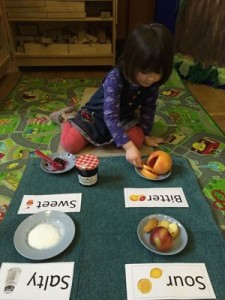
Understanding the world covers a vast area of learning including science, ICT, geography, nature studies and learning about other people’s beliefs and cultures. The Montessori materials include the pink tower, cylinder blocks, broad stair, red rods, smelling jars, colour tablets, baric tablets, sound boxes, geometric solids. Sensorial materials teach the concepts of colour, weight, shape, texture, size, sound and smell in an enjoyable and fun way.
Geography
Globes, maps, flags, land/water forms and topics on continents/countries of the world all help to broaden the child’s horizon and introduce them to the different features of the countries their families and friends come from. This helps the child to value and respect themselves and others.
Nature studies/Botany
The nature table is a very important feature of the Montessori classroom. Children are encouraged to collect and display flowers, leaves and have access to several natural resources to explore such as shells, rocks and fir cones. Seasons offers rich experiences to the Montessori child, one which links a multitude of subjects together such as the weather, agriculture and landscape, colour, shape and texture, are all examples of the new and exciting changes that the season brings. The importance of being outdoors helps the child to use the natural environment to learn such as collecting, exploring, climbing and listening. Such experiences gives the child first hand contact with the weather, seasons and natural world, whilst offering freedom to explore, use their senses and to be physically active.
Outings
We organise formal outings at least every academic year. It is hoped that these outings will enhance and re-enforce, in a practical way, what your child is learning in the nursery. There are opportunities for the children to go on daily outings with their class teacher (only if parental consent is given) such as visiting the local shops, looking at the buildings in the area, going to Walker School to use the recycling facilities etc. These outings complement the activities taking place in the classroom and provide the opportunity for an extra level of involvement in the theme or topic being explored.
Science
The children are introduced to simple scientific experiments, exploring the basic laws of light, gravity, sound, magnetism etc.
Cultural studies
We celebrate diversity within our nursery and celebrate the different festivals and events that take place during the year from a variety of different cultures and religions.
I.C.T
The children have access to a wide variety of I.C.T equipment such as the computer (laptop), music players, light & sound operated resources, toy mobile phones etc. The computer plays an integral part of everyday life at START RIGHT. The children learn to carry out a variety of functions while using the computer for different purposes. The computer reinforces the other areas of the curriculum such as reading, writing and mathematics. All of the software we use has educational value with a learning purpose but is also entertaining for the children. Through regular use of the computer the children are able to develop their mouse control and therefore use the computer independently.
Creativity forms the basis for much of the learning that takes place at START RIGHT. We strongly believe that children should have plenty of opportunities to express themselves in an imaginative way and creative thinking is an essential part of learning in many subject areas, not just the ‘arts’. Daily activities include singing, dancing/movement, role play and arts and crafts.
Arts and Design
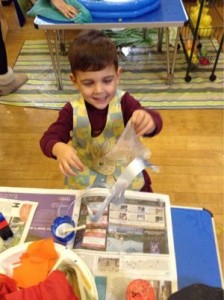
There are many activities available to the children each day including painting, drawing, stencilling, collages, gluing and sticking, clay/dough and model making. There are a variety of resources for children’s mark-making such as chalk, ink stamps, colouring pens and pencils, crayons and pastels. The easel is always available for children who want to paint.
The activities on offer allow the children to develop a variety of art techniques in a fun and enjoyable way. They are able to express their ideas make choices over their work and enjoy the process of their art rather than just focusing on the end product. We display samples of the children’s artwork in the lobby and they bring home anything they have created on a weekly basis.
Music
We listen to music throughout the daily routine and have a vast music collection including classical, jazz, folk, world, traditional, children’s songs, relaxation and more! We introduce the children to the names of different instruments and they attempt to identify them in the music they hear. Singing, moving to music and using different instruments helps to promote an appreciation for music, develop body awareness, gross motor co-ordination and also helps to increase memory, imagination and concentration.
Start Right Montessori Nursery Concert
Music offers the children the opportunity to explore their own creativity and inspires them to explore their own thoughts, feelings and interpretation of the variety of sounds they hear and what it means to them. This creative exploration thereby develops their personal, social and emotional developmental skills. Our nursery concert is a lasting musical experience for both the children, parents/ guardians and close relatives (usually held in Autumn Term). Children experience the excitement of a musical journey through singing, dancing, role-play and playing musical instruments.
Music and the classroom environment
Our Montessori classroom promotes a calm and peaceful atmosphere and as you step inside the classroom you will hear relaxing music playing from around the world. Relaxation music is played during our YOGA exercises and breathing techniques.
Ofsted Report
Every early years setting is the subject of an Ofsted report which reflects the quality of the provision on offer, including; the environment, care, education, partnership with parents/carers and more. We have a hard copy of our most recent report(s) for you to read or you may access the original from the Ofsted website by clicking on the button.
